Pablo Picasso in the Suñol Soler Collection

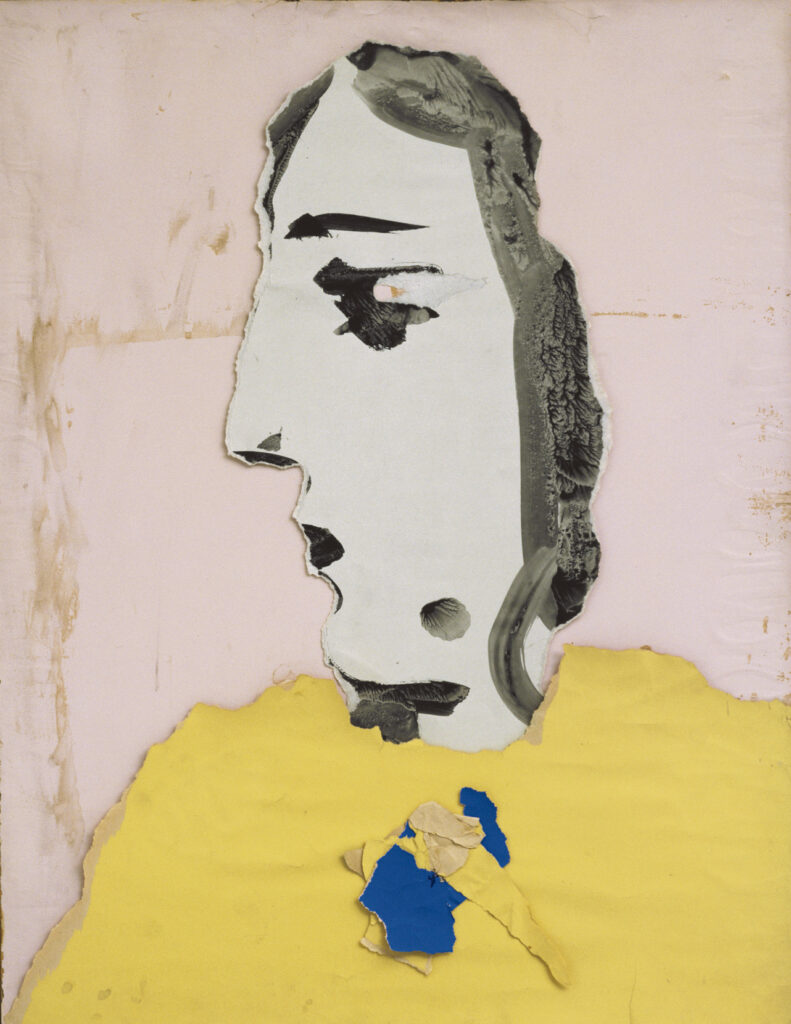
Buste de femme à a la bluse jaune
París, 1943
Collage on foam board
65 × 60 cm
Christian Zervos, París, Cahiers d’Art, 33 volumes; vol. XII, 1983, num. 256
Suñol Soler Collection
This work was made in Picasso’s studio on Rue des Grands-Augustins in Paris, in the midst of the German occupation. Using scissors and his hands, Picasso cut out the shape of a woman’s head, glued it onto a support and coloured in the most distinctive features – eyes, lips and eyebrows – before adorning it with a medallion or flower made from small pieces of paper in different colours, contrasting with the yellow of the blouse.
Despite its originality, the portrait is not an isolated work but part of a broader group of related works. Picasso’s mastery of collage and assemblage runs through many phases of his output, from Cubism through to the 1960s, and retains its vitality throughout. The directness of the materials gives the work a primitive beauty charged with surprising and sensual ideas.
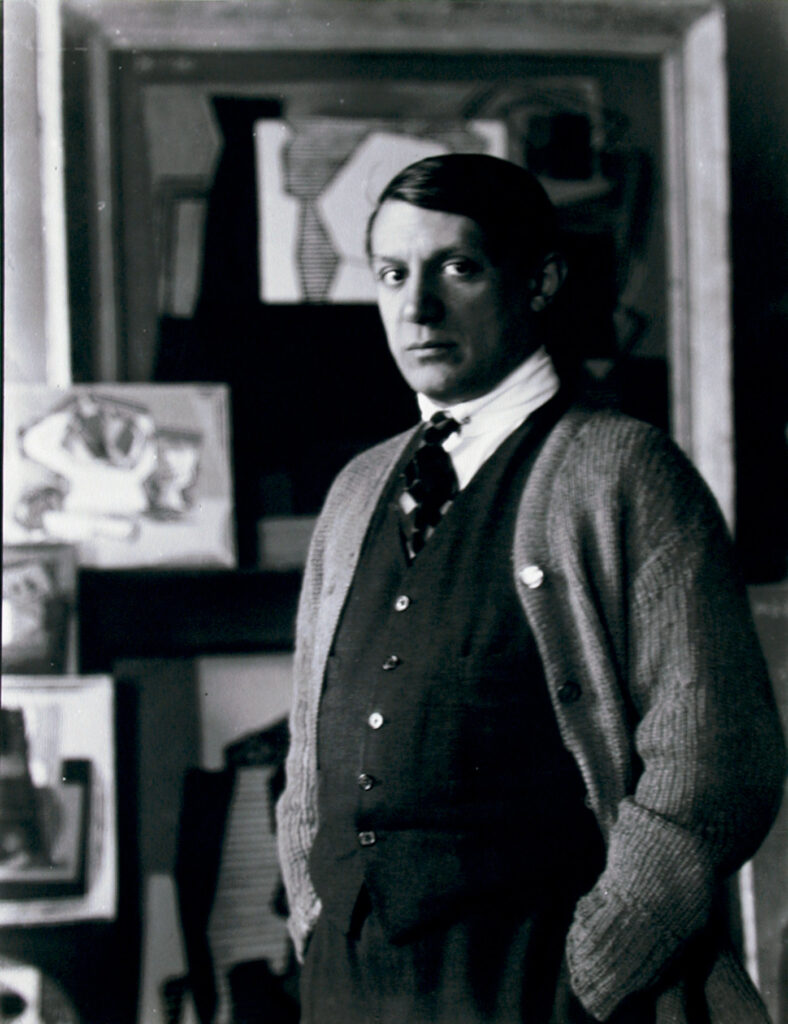
Around the same time, Picasso was making sculptures from found objects – among them Bull’s Head, assembled from a bicycle saddle and handlebars; Woman in a Long Dress, in which a plaster-modelled head and arm are attached to a dressmaker’s mannequin; and Gas Venus, in which the burner and piping of a gas stove are turned into a female figure. It was also during these months that, to amuse his companion Dora Maar, the artist made a series of figures by tearing, scoring and cutting paper napkins. These cut-out figures echo works from his childhood – pieces made in 1890 from cut paper for his sisters to play with – as well as the Cubist musical instruments assembled from paper, cardboard and everyday objects; the toys he made for his children, first for Maya and later for Claude and Paloma; and the sheet-metal sculptures of the 1950s.
A photograph taken by Georgette Chadourne in 1945 at Paul Éluard’s home at 35 Rue de la Chapelle in Paris confirms that this collage formed part of the poet’s collection.
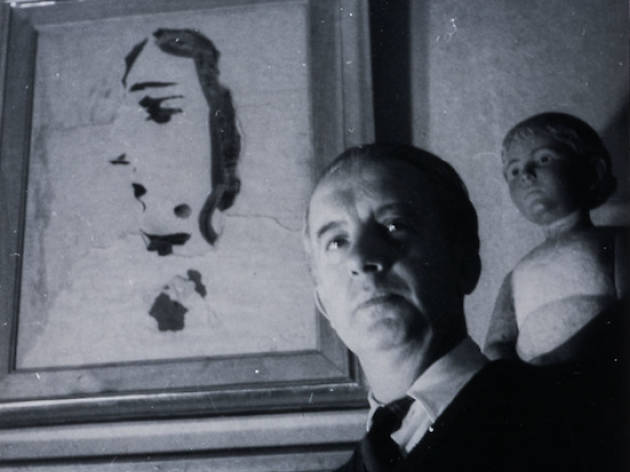
Although the two had known each other since the 1920s, it was in 1935 that Éluard entered Picasso’s innermost circle, and they maintained an unshakeable friendship until the poet’s death. Over a long period spanning the Spanish Civil War, the Second World War and the Liberation of France, their relationship deepened into something close to a creative alliance – a partnership united by shared perspectives in art and creative practice, personal affinity and political conviction.
This friendship gave rise to vivid and intense artistic exchanges. Éluard served as Picasso’s ambassador in Spain for the artist’s exhibition organised by the group ADLAN (Amics de l’Art Nou) in 1936 and played a key role in fostering Picasso’s political commitment – both during the Spanish Civil War and in his engagement with the pacifist movements that followed, which led Picasso to develop an entire iconography of peace. Éluard wrote poems about Picasso, who in turn illustrated numerous books by the poet and also collected his work, acquiring pieces both through purchase and as gifts from the artist himself.
The poet assembled works by Picasso at various points in his life: it has been estimated that some 65 pieces passed through his collection, which was a fluid one, with works constantly coming and going. As early as 1924 he sold several works from Picasso’s Rose and Cubist periods, probably acquired at one of the Kahnweiler sales. Éluard continued to buy and sell – sometimes as an intermediary, sometimes as an adviser, thanks to his close relationships with Picasso, Dalí and Ernst. Pressed by financial difficulties, he did not hesitate to sell works given to him by his artist friends – among them, in 1933, the collector’s edition of Ovid’s Metamorphoses that Picasso had given him, and, in 1938, the recent portrait of Nusch. Following the sale of his collection to Roland Penrose in 1938, Éluard assembled a new Picasso collection, consisting largely of gifts from the artist – testament to Picasso’s enduring generosity towards his friends.
In 1943 Éluard was a frequent visitor to the studio on Rue des Grands-Augustins, and it was probably on one of these visits that Picasso made this portrait – merging the features of Dora Maar and Nusch Éluard – and gave it to the poet, who was facing considerable financial hardship and the constraints of censorship at the time. Éluard displayed it in his home, but shortly after the end of the war sold it to the Galerie Louise Leiris, run by the legendary Cubist dealer Daniel-Henry Kahnweiler. Since the 1940s, Bust of a Woman in a Yellow Blouse has attracted scholarly attention and featured in major studies of Picasso’s work. In 1979 it was acquired by the collector and philanthropist Josep Suñol Soler and is now part of the Suñol Soler Collection, preserved and promoted by the Fundació Suñol. The work has featured in numerous significant exhibitions relating to the artist, Surrealism and collage, among them Picasso 1881–1973. Anthological Exhibition at the Museo de Arte Contemporáneo in Madrid and the Museu Picasso in Barcelona, 1981–1982; Pablo Picasso, Paul Éluard. A Sublime Friendship at the Museu Picasso in Barcelona, 2019, and at the Musée d’art et d’histoire Paul Éluard in Saint-Denis, 2023; and Miró/Picasso, a joint exhibition by the Fundació Joan Miró and the Museu Picasso de Barcelona, 2023–2024.
Malén Gual
Curator, Museu Picasso de Barcelona (2007–2021)
Arxiu complementari
Compartir